
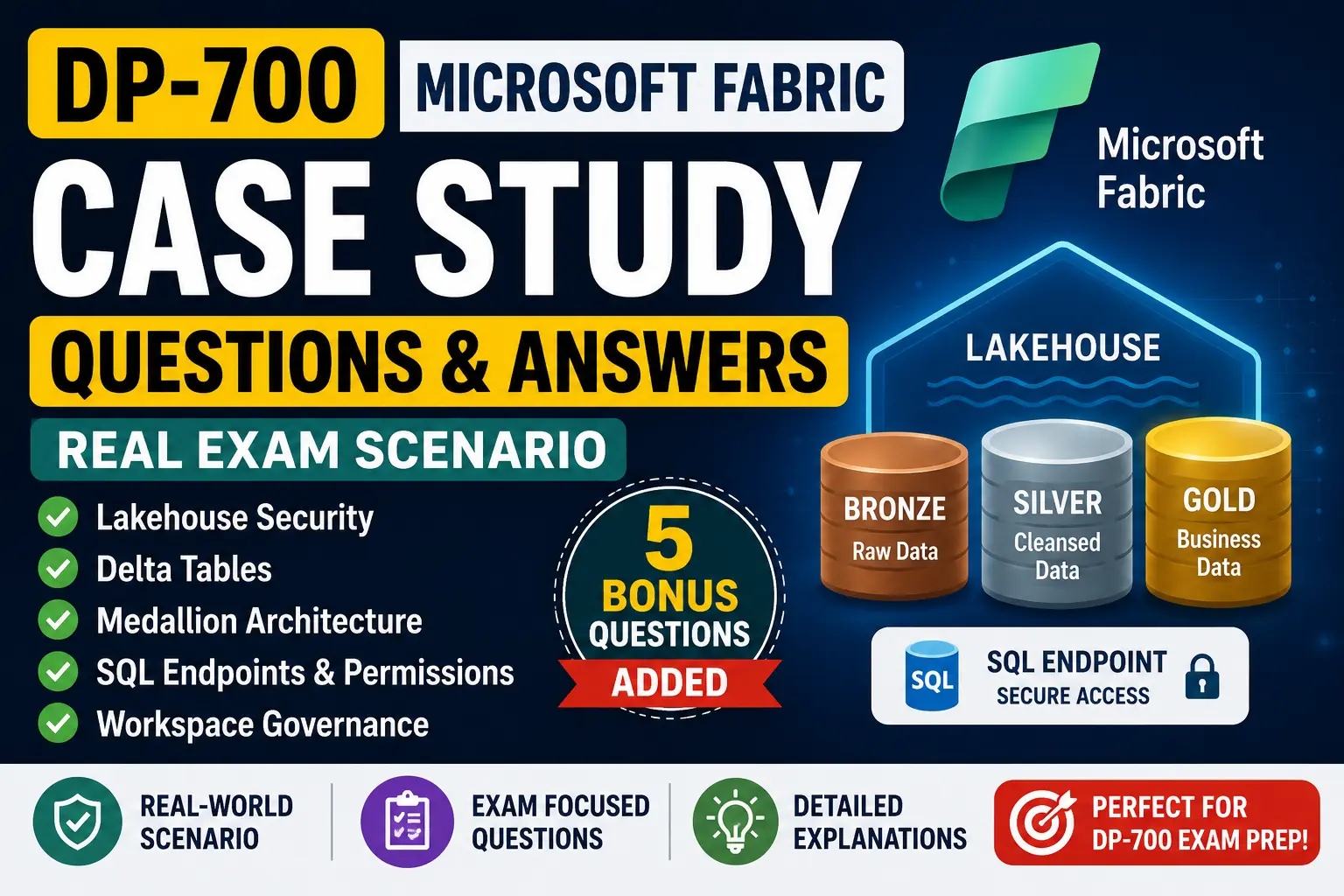
DP-700 Microsoft Fabric Case Study Questions and Answers (Latest Real Exam Scenario)
Preparing for the Microsoft DP-700 Fabric Engineer certification exam?
This detailed case study covers real-world Microsoft Fabric implementation scenarios including
Lakehouse security, Delta tables, medallion architecture, SQL endpoints, Azure Repos integration,
and Fabric workspace governance.
Before attempting this advanced case study, we highly recommend reviewing our
DP-700 Practice Questions Set-1
guide that covers Data Pipelines, Eventhouse, Direct Lake optimization, V-Order optimization, and Star Schema concepts frequently asked in the DP-700 exam.
Case Study Overview
Contoso Ltd. is an online retail company that plans to modernize its analytics platform by migrating to Microsoft Fabric.
The company wants to improve marketing analytics, reduce reporting delays, and implement enterprise-grade data governance using Fabric.
The IT department contains:
- Data Engineers responsible for ingestion, transformation, and loading.
- Data Analysts responsible for semantic models, reporting, and analytical dashboards.
Data engineers mainly use Python and SQL, while analysts use Power Query and T-SQL for querying and reporting.
Existing Fabric Environment
- Fabric Capacity: F64 (Cap1)
- Workspaces: WorkspaceA and WorkspaceB
- License Mode: Pro
- All Fabric users can create Fabric items.
Existing Source Systems
Contoso currently uses multiple enterprise data sources:
- POS1 application hosted on SQL Server inside Azure Virtual Machines.
- MARI SaaS marketing platform.
- Amazon S3 bucket storing historical Parquet files.
The POS1 SQL Server VM belongs to the same Microsoft Entra tenant as Fabric and runs inside a private network with public access disabled.
The MARI platform stores marketing interaction data including:
- Email open rates
- Campaign interaction rates
- Website activity metrics
Historical MARI data is stored in Amazon S3 as Parquet files ranging from 300 MB to 900 MB.
Product Data Structure
The POS1 product database contains the following tables:
- Products
- ProductCategories
- ProductSubcategories
Products are related to subcategories, and subcategories are related to product categories.
Security Groups
- DataAnalysts — Contains all analysts.
- DataEngineers — Contains all engineers.
Current Business Challenge
The VP of Marketing needs faster insights into email campaign performance.
Currently, analysts manually compile reports which takes nearly one full day.
The company wants to reduce reporting time to less than one hour using Microsoft Fabric.
The engineering team also experiences transient connectivity failures during ingestion from MARI exports.
Planned Architecture Changes
Contoso plans to implement two Fabric lakehouses:
- Lakehouse1 — Stores raw and cleansed data.
- Lakehouse2 — Stores dimensional models for analytics.
The company also plans to:
- Implement medallion architecture.
- Use Azure Repos for source control.
- Automate ingestion and transformation pipelines.
- Store reports and semantic models in WorkspaceB.
Technical Requirements
- Implement bronze, silver, and gold layers.
- Perform intensive transformations only in the silver layer.
- Use Delta format in the bronze layer.
- Prevent unnecessary copies of Amazon S3 raw data.
- Retry ingestion automatically after connectivity failures.
- Send email notifications if ingestion fails.
- Clean unused Delta logs weekly.
Security Requirements
- Data engineers must have full access to lakehouses.
- Data analysts should only access gold layer Delta tables.
- Data analysts must NOT access bronze or silver layers.
- Data engineers must commit changes to WorkspaceA source control.
DP-700 Microsoft Fabric Question
Question:
You need to ensure that data analysts can access the gold layer lakehouse while preventing access to bronze and silver layers. What should you do?
Options
- A. Add the DataAnalyst group to the Viewer role for WorkspaceA.
- B. Share the lakehouse and grant Build permission on the semantic model.
- C. Share the lakehouse and grant Read all SQL Endpoint data permission.
- D. Share the lakehouse and grant Read all Apache Spark permission.
Correct Answer
Answer: C — Share the lakehouse and grant Read all SQL Endpoint data permission.
Detailed Explanation
Granting Read all SQL Endpoint data permission is the best approach because it allows analysts to query only the required gold layer tables using SQL endpoints.
This method prevents direct access to bronze and silver layers while still enabling analytical reporting capabilities.
This solution follows the Principle of Least Privilege, which is a critical Microsoft Fabric and Azure security best practice.
Why Other Options Are Incorrect
- Option A: Viewer role may expose broader workspace visibility than required.
- Option B: Build permission applies to semantic models, not secure lakehouse table access.
- Option D: Apache Spark permissions can expose underlying bronze and silver layer data.
5 Additional DP-700 Practice Questions
1. Which file format should be used in the bronze layer of the lakehouse?
- CSV
- Delta ✅
- JSON
- Excel
2. Which Microsoft Fabric component is best suited for storing raw ingested data?
- Semantic Model
- Power BI Dashboard
- Lakehouse ✅
- Warehouse
3. Which tool should be used for source control integration in Fabric?
- SharePoint
- FTP
- Azure Repos ✅
- OneDrive
4. Which medallion layer contains cleaned and transformed data?
- Bronze
- Silver ✅
- Cold Storage
- Archive
5. What is the best way to handle transient connectivity failures during ingestion?
- Disable the pipeline
- Delete failed jobs
- Automatic Retry Mechanism ✅
- Manual restart only
DP-700 Preparation Tips
- Understand Fabric Lakehouse security deeply.
- Practice medallion architecture questions regularly.
- Learn Delta table optimization concepts.
- Focus on Fabric workspace permissions and SQL endpoints.
- Study Direct Lake and semantic model security.
Continue Your DP-700 Preparation
If you want more real exam-style Microsoft Fabric questions, check out our previous practice set covering:
- Direct Lake optimization
- Eventhouse
- Data Pipelines
- V-Order optimization
- Star Schema modeling
SEO Keywords
- DP-700 Questions and Answers
- Microsoft Fabric Case Study
- DP-700 Real Exam Questions
- Fabric Lakehouse Security
- Microsoft Fabric Interview Questions
- Delta Tables in Microsoft Fabric
- Medallion Architecture in Fabric
- Fabric SQL Endpoint Permissions
Conclusion
This Microsoft Fabric DP-700 case study explains real enterprise implementation scenarios including lakehouse permissions, Delta tables, ingestion pipelines, and medallion architecture.
If you are serious about clearing the DP-700 certification exam, mastering these practical Microsoft Fabric scenarios is extremely important.