
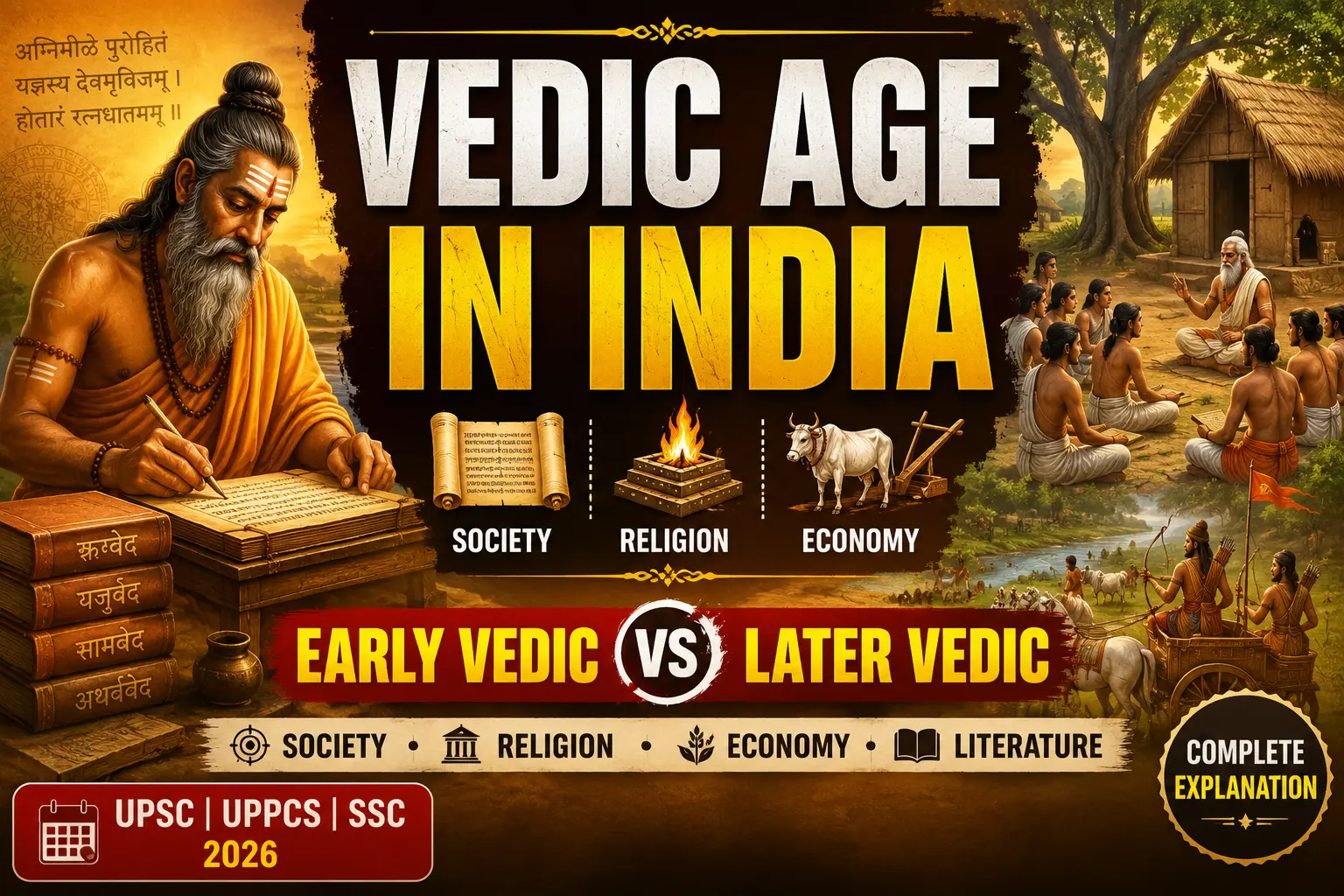
Vedic Age in India: Early Vedic and Later Vedic Period Explained
Meta Title: Vedic Age in India: Early Vedic and Later Vedic Period Explained
Meta Description: Learn about the Vedic Age in India, including Early Vedic and Later Vedic society, economy, polity, religion, literature, and key differences.
Suggested URL Slug: vedic-age-in-india
Focus Keyword: Vedic Age in India
Secondary Keywords: Early Vedic Age, Later Vedic Age, Rig Vedic Period, Vedic Literature, Vedic Society
Introduction
The Vedic Age in India is one of the most important periods in ancient Indian history. It laid the foundation for many social, religious, political, and cultural traditions that later shaped Indian civilization.
This period is mainly divided into two phases: the Early Vedic Age, also known as the Rig Vedic Period, and the Later Vedic Age. The Early Vedic period was largely pastoral, tribal, and less complex, while the Later Vedic period saw the rise of agriculture, Janapadas, hereditary kingship, social hierarchy, and elaborate rituals.
In this blog post, we will understand the Vedic Age in a simple and exam-oriented way, covering its literature, society, polity, economy, religion, and major differences between the Early and Later Vedic periods.
What is the Vedic Age?
The Vedic Age refers to the period in ancient Indian history when the Vedas were composed. The Vedas are considered the earliest literary sources of Indian civilization.
The Vedic Age is generally divided into:
- Early Vedic Age: 1500–1000 BCE
- Later Vedic Age: 1000–600 BCE
The Early Vedic Age is mainly associated with the Rig Veda, while the Later Vedic Age saw the composition of the Sama Veda, Yajur Veda, Atharva Veda, and other texts like Brahmanas, Aranyakas, and Upanishads.
Origin of the Aryans
According to the Aryan Migration theory, the Aryans are believed to have migrated from Central Asia and entered the Indian subcontinent through the north-western region. They gradually settled in the Sapta Sindhu region, which included Punjab and surrounding areas.
The theory is supported by linguistic similarities among Indo-European languages and common cultural symbols found across Indo-European cultures.
The indigenous people mentioned in Vedic texts were called Dasyus, meaning enemies or non-Aryans. The term Dasyuhatya also appears in Vedic literature, referring to the destruction of enemies.
Vedic Literature
Vedic literature forms the backbone of the Vedic Age. These texts were considered Apaurushaya, meaning not created by humans but divinely revealed. They were also classified as Shruti, meaning “heard” texts, because they were passed orally from one generation to another.
The main components of Vedic literature are:
- Four Vedas
- Brahmanas
- Aranyakas
- Upanishads
The core collection of hymns in each Veda is known as Samhita.
The Four Vedas
1. Rig Veda
The Rig Veda is the oldest Veda and one of the oldest literary compositions in the world. It contains hymns dedicated to various deities such as Indra, Agni, Soma, Varuna, and Surya.
It consists of 10 Mandalas. The 2nd to 7th Mandalas are considered the oldest, while the 1st and 10th Mandalas are believed to be later additions.
The Rig Veda gives us important information about the Early Vedic society, economy, religion, and geography.
2. Sama Veda
The Sama Veda is known as the oldest musical text of India. It mainly consists of Rig Vedic hymns arranged in musical form for chanting during rituals.
3. Yajur Veda
The Yajur Veda deals with the procedures of sacrifices and rituals. It has two major divisions:
- Krishna Yajur Veda
- Shukla Yajur Veda
4. Atharva Veda
The Atharva Veda contains hymns related to medicine, healing practices, magical charms, and spells. It also reflects the assimilation of non-Aryan beliefs into Vedic culture.
Early Vedic Age
The Early Vedic Age, also called the Rig Vedic Period, lasted from around 1500 BCE to 1000 BCE. During this period, society was mainly pastoral, tribal, and semi-nomadic.
Geography of the Early Vedic Period
The Early Vedic people mainly lived in the Sapta Sindhu region, which means the land of seven rivers. The river Indus, known as Sindhu, was very important in Rig Vedic geography.
Important rivers mentioned in the Rig Veda include:
- Indus or Sindhu
- Jhelum or Vitasta
- Chenab or Askini
- Ravi or Parushni
- Beas or Vipasha
- Sutlej or Shatudri
- Sarasvati
The Ganga and Yamuna are mentioned only a few times, which suggests that the Aryans had not yet expanded deeply into the eastern Gangetic region during the Early Vedic period.
Political Life in the Early Vedic Age
The political structure of the Early Vedic Age was simple and tribal. The basic units of society were Jana and Vish, meaning tribe and people.
The chief was known as Rajan. However, kingship was not hereditary in the early phase. The Rajan was usually chosen by the people based on ability and acceptance.
Important political and administrative units included:
- Kul: Family, headed by Kulapati
- Grama: Village, headed by Gramini
- Vish: Clan, headed by Vispati
- Jana: Tribe, protected by Gopa or Gopati
There was no permanent capital, no regular army, no fixed taxation system, and no modern state structure. The Rajan lived like other members of the community.
Tribal Assemblies
Tribal assemblies played an important role in governance. Important assemblies were:
- Vidhata: The earliest tribal assembly
- Sabha: Assembly of selected elders
- Samiti: General assembly of the people
- Gana: Assembly of warriors
These assemblies limited the power of the Rajan and helped in decision-making.
Battle of Ten Kings
One of the most important political events of the Early Vedic Age was the Battle of Dasrajanah, also known as the Battle of Ten Kings. It was fought on the banks of the Parushni River, identified with the Ravi River.
The battle was fought between the Bharata tribe and a confederacy led by the Puru tribe. The Bharatas emerged victorious, showing the importance of inter-tribal rivalry in this period.
Economic Life in the Early Vedic Age
The Early Vedic economy was mainly pastoral. Cattle, especially cows, were considered the most important form of wealth. Cows were so valuable that many prayers in the Rig Veda ask for cattle and horses.
Horses were also important because they were used in warfare, chariots, and mobility.
Agriculture existed but was not the main occupation. The economy was based on a barter system, as metallic coinage was not used during this period.
Important features of the Early Vedic economy were:
- Pastoral and semi-nomadic lifestyle
- Cattle as the main unit of wealth
- Limited agriculture
- Use of horses and chariots
- Barter system
- No metallic coinage
Social Life in the Early Vedic Age
Early Vedic society was tribal, clan-based, and relatively egalitarian. The Varna system had started to emerge, but it was not rigid or birth-based. It was mainly based on occupation.
The four Varnas were:
- Brahmin
- Kshatriya
- Vaishya
- Shudra
The Purusha Sukta of the 10th Mandala of the Rig Veda explains the symbolic origin of the four Varnas.
Position of Women in Early Vedic Society
Women enjoyed a comparatively better position during the Early Vedic Age. They could participate in yajnas and some tribal assemblies. Some women even composed hymns and were known as Brahmavadinis.
Important Brahmavadinis included:
- Apala
- Lopamudra
- Vishwavara
- Ghosha
- Maitreyi
Child marriage and Sati were absent in this period. However, society was gradually becoming patriarchal, as sons were preferred and inheritance became patrilineal.
Religion in the Early Vedic Age
Early Vedic religion was nature-centric. People worshipped natural forces such as rain, fire, wind, sun, and earth.
There were no temples and no idol worship. Worship was performed through hymns, prayers, and yajnas.
Important Early Vedic deities were:
- Indra: God of rain, thunder, and war
- Agni: God of fire and messenger between humans and gods
- Varuna: Guardian of cosmic order or Rita
- Surya: Sun god
- Soma: Sacred drink and moon deity
- Usha: Goddess of dawn
- Vayu: God of wind
- Rudra: God of animals and wild nature
Indra was the most important deity of the Rig Vedic period.
Later Vedic Age
The Later Vedic Age lasted from around 1000 BCE to 600 BCE. This period witnessed major changes in society, economy, polity, and religion.
The Aryans expanded eastward into the Gangetic plains. Agriculture became more important, Janapadas emerged, and the political system became more centralized.
Later Vedic Literature
During the Later Vedic Age, three new Vedas were composed:
- Sama Veda
- Yajur Veda
- Atharva Veda
Other important texts were also composed during this period.
Brahmanas
The Brahmanas explain the meaning and procedures of Vedic rituals. They mainly focus on sacrifices like Ashvamedha and Rajasuya.
The Shatapatha Brahmana is considered one of the most important Brahmana texts.
Aranyakas
The Aranyakas, also called forest texts, were meant for hermits and students living in forests. They mark a shift from external rituals to internal reflection.
Upanishads
The Upanishads are also known as Vedanta, meaning the end or culmination of Vedic thought. They focus on deep philosophical ideas such as:
- Dharma
- Karma
- Atman
- Brahman
- Moksha
The Upanishads marked a major shift from ritualism to spiritual introspection.
Political Life in the Later Vedic Age
The Later Vedic period saw the rise of Janapadas, or territorial states. Small tribal units developed into larger political units.
Important Janapadas included:
- Kuru
- Panchala
- Kashi
- Matsya
Kingship became more powerful and hereditary. The Rajan was no longer just a tribal chief; he became a territorial ruler.
Rajan-Brahmana Alliance
A strong alliance developed between kings and Brahmanas. Kings depended on Brahmanas for ritual legitimacy, while Brahmanas received royal patronage.
Royal sacrifices like Rajasuya and Ashvamedha were performed to increase the authority and prestige of the king.
Administration and Taxation
For the first time, regular taxation began. Usually, one-sixth of the agricultural produce was collected as tax.
A more organized administration developed with officials such as:
- Bhagdugha: Tax collector
- Suta: Royal charioteer and envoy
- Akshavapa: Courier or messenger
- Sthapati: Administrator of frontier regions
- Ugra: Police official
- Gramini: Village head
The king became the final judicial authority, and Brahmanas helped him in legal and religious matters.
Economic Life in the Later Vedic Age
The Later Vedic economy became primarily agricultural. People became more settled, and agriculture replaced pastoralism as the main occupation.
The use of iron tools, especially the iron ploughshare, helped in clearing forests and increasing agricultural production.
Major crops included:
- Rice
- Wheat
Crafts and occupations also became more specialized. Chariot makers, carpenters, metalworkers, weavers, and tanners became important.
Trade and Guilds
Guilds, known as Shrenis, emerged during this period. They were mainly organized by Vaishyas and helped regulate trade and crafts.
Terms like Nishka, Suvarna, Shatamana, and Krishnala appeared, suggesting an emerging idea of proto-coinage. However, there is no clear archaeological evidence of physical coins from this period.
Social Life in the Later Vedic Age
The social structure became more rigid during the Later Vedic Age. The Varna system became increasingly hereditary and hierarchical.
The first three Varnas — Brahmin, Kshatriya, and Vaishya — were known as Dvijas, or twice-born. They were allowed to perform the Upanayana ceremony.
The position of Shudras declined, and social stratification increased. The idea of untouchability also began to emerge around the end of this period.
Ashrama System
The four Ashramas were systematized in the Later Vedic period:
- Brahmacharya: Student life
- Grihastha: Householder life
- Vanaprastha: Forest-dweller stage
- Sanyasa: Renunciation
Position of Women in the Later Vedic Age
The status of women declined significantly during the Later Vedic period. Women were excluded from Sabha and Samiti, and their access to Vedic education was reduced.
They were increasingly confined to domestic roles. Practices such as dowry, child marriage, and ideas of purity became stronger.
Later Vedic Religion
Religion became more ritualistic and complex in the Later Vedic Age. Yajnas and sacrifices became more elaborate and were often performed by Brahmanas.
Important deities of the Later Vedic period included:
- Prajapati
- Vishnu
- Rudra
Prajapati emerged as the creator of the universe. Vishnu became more important, while Rudra later developed into the figure of Shiva.
Rise of Philosophy
The Upanishads introduced deeper philosophical ideas. Concepts like Karma, Dharma, Atman, Brahman, and Moksha became central to Indian thought.
This period also saw a shift from ritual sacrifice to spiritual knowledge and inner realization.
Difference Between Early Vedic and Later Vedic Period
| Feature | Early Vedic Period | Later Vedic Period |
|---|---|---|
| Time Period | 1500–1000 BCE | 1000–600 BCE |
| Main Text | Rig Veda | Sama, Yajur, Atharva Veda, Brahmanas, Aranyakas, Upanishads |
| Economy | Pastoral and semi-nomadic | Agricultural and settled |
| Political System | Tribal system | Territorial Janapadas |
| Kingship | Non-hereditary | Hereditary |
| Assemblies | Sabha and Samiti were important | Assemblies declined |
| Society | Relatively egalitarian | More hierarchical |
| Varna System | Flexible and occupation-based | Rigid and birth-based |
| Women | Better status and participation | Decline in status |
| Religion | Nature worship and simple rituals | Elaborate sacrifices and rituals |
| Geography | Sapta Sindhu region | Expansion into Gangetic valley |
Importance of the Vedic Age
The Vedic Age is important because it shaped the early foundations of Indian civilization. Many ideas that became central to Indian society and culture developed during this period.
Its importance can be understood through the following points:
- It gave India its earliest literary texts, the Vedas.
- It laid the foundation of social institutions like Varna and Ashrama.
- It introduced important religious and philosophical concepts.
- It saw the beginning of political evolution from tribes to Janapadas.
- It contributed to the growth of Sanskrit literature.
- It shaped early ideas of Dharma, Karma, Atman, and Brahman.
Conclusion
The Vedic Age in India was a transformative period in ancient Indian history. The Early Vedic Age was marked by pastoral life, tribal politics, simple religion, and a relatively flexible society. In contrast, the Later Vedic Age witnessed settled agriculture, territorial kingdoms, hereditary kingship, social hierarchy, and elaborate rituals.
The period also produced some of the most important texts of Indian civilization, including the Vedas, Brahmanas, Aranyakas, and Upanishads. These texts not only shaped religion and philosophy but also influenced Indian society for centuries.
Understanding the Vedic Age helps us understand the roots of Indian culture, social structure, political development, and spiritual traditions.
FAQs on Vedic Age in India
1. What is the Vedic Age?
The Vedic Age is the period in ancient Indian history during which the Vedas were composed. It is divided into the Early Vedic Age and Later Vedic Age.
2. What is the time period of the Early Vedic Age?
The Early Vedic Age is generally dated from 1500 BCE to 1000 BCE.
3. What is the time period of the Later Vedic Age?
The Later Vedic Age is generally dated from 1000 BCE to 600 BCE.
4. Which is the oldest Veda?
The Rig Veda is the oldest Veda and one of the oldest literary texts in the world.
5. What was the main occupation of Early Vedic people?
The main occupation of Early Vedic people was cattle rearing. Agriculture was limited during this period.
6. What was the main occupation in the Later Vedic Age?
Agriculture became the main occupation during the Later Vedic Age.
7. Which deity was most important in the Early Vedic Age?
Indra was the most important deity of the Early Vedic Age.
8. What are Janapadas?
Janapadas were larger territorial states that emerged during the Later Vedic Age.
9. How did the position of women change from Early to Later Vedic Age?
Women enjoyed a better position in the Early Vedic period, but their status declined in the Later Vedic period as patriarchy became stronger.
10. Why is the Vedic Age important?
The Vedic Age is important because it laid the foundation of Indian religion, philosophy, society, polity, and literature.